- Welcome to Oil and Gas World Community.

A Community by the Industry and for the Industry

Recent posts
#51
South Asia / Re: India - Krishna Godavari -...
Last post by Administrator - Apr 11, 2026, 03:19 AMReliance and bp start up second new deepwater gas field in India's KG D6 block
Reliance Industries Limited (RIL) and bp today announced the start of production from the Satellite Cluster gas field in block KG D6 off the east coast of India.
RIL and bp have been developing three deep-water gas developments in block KG D6 – R Cluster, Satellite Cluster and MJ – which together are expected to produce around 30 mmscmd (1 billion cubic feet a day) of natural gas by 2023, meeting up to 15% of India's gas demand. The developments will each utilize the existing hub infrastructure in the KG D6 block. RIL is the operator of the block with a 66.67% participating interest and bp holds a 33.33% participating interest.
The Satellite Cluster is the second of the three developments to come onstream, following the start-up of R Cluster in December 2020. It had originally been scheduled to start production in mid-2021. The field is located about 60 km from the existing onshore terminal at Kakinada on the east coast of India in water depths of up to 1850 meters.
The field will produce gas from four reservoirs utilizing a total of five wells and is expected to reach gas production of up to 6 mmscmd. Together, the R Cluster and Satellite Cluster are expected to produce about 20% of India's current gas production.
The third KG D6 development, MJ, is expected to come onstream towards the latter half of 2022.
- Satellite Cluster field comes onstream two months ahead of schedule despite Covid-19 challenges
- Second in trio of developments together expected to meet ~15% of India's gas demand
Reliance Industries Limited (RIL) and bp today announced the start of production from the Satellite Cluster gas field in block KG D6 off the east coast of India.
RIL and bp have been developing three deep-water gas developments in block KG D6 – R Cluster, Satellite Cluster and MJ – which together are expected to produce around 30 mmscmd (1 billion cubic feet a day) of natural gas by 2023, meeting up to 15% of India's gas demand. The developments will each utilize the existing hub infrastructure in the KG D6 block. RIL is the operator of the block with a 66.67% participating interest and bp holds a 33.33% participating interest.
The Satellite Cluster is the second of the three developments to come onstream, following the start-up of R Cluster in December 2020. It had originally been scheduled to start production in mid-2021. The field is located about 60 km from the existing onshore terminal at Kakinada on the east coast of India in water depths of up to 1850 meters.
The field will produce gas from four reservoirs utilizing a total of five wells and is expected to reach gas production of up to 6 mmscmd. Together, the R Cluster and Satellite Cluster are expected to produce about 20% of India's current gas production.
The third KG D6 development, MJ, is expected to come onstream towards the latter half of 2022.
#52
South Asia / Re: India - Krishna Godavari -...
Last post by Administrator - Apr 11, 2026, 03:19 AMKG D6 Satellites
The Satellites project is the second of three projects in Block KG D6 off the east coast of India. It is a dry gas development and comprises four discoveries in 4,300 - 6,200 feet water depth. It will be developed as a five well subsea tie back to the existing control and riser platform off Block KG D6. KG D6 integrated development is aimed at delivering one billion standard cubic feet gross production a day by 2022 and supports country agenda by increasing domestic gas supply.
The Satellites project is the second of three projects in Block KG D6 off the east coast of India. It is a dry gas development and comprises four discoveries in 4,300 - 6,200 feet water depth. It will be developed as a five well subsea tie back to the existing control and riser platform off Block KG D6. KG D6 integrated development is aimed at delivering one billion standard cubic feet gross production a day by 2022 and supports country agenda by increasing domestic gas supply.
- Location India
- Operator Reliance
- Partners Reliance (66.67%), BP (33.33%)
- Project type Dry gas
- Start-up 2021
- Peak annual average production, gross ~45 mboed
- Peak annual average production, net ~15 mboed
#53
South Asia / Re: India - Krishna Godavari -...
Last post by Administrator - Apr 11, 2026, 03:18 AMKG D6 R Cluster
The R Cluster project is the first of three projects in Block KG D6 off the east coast of India. The gas field is located approximately 45 miles offshore in water-depths of more than 6,500 feet. The R Cluster project was developed as a six well subsea tie back to the existing control and riser platform off Block KG D6.
The R Cluster project is the first of three projects in Block KG D6 off the east coast of India. The gas field is located approximately 45 miles offshore in water-depths of more than 6,500 feet. The R Cluster project was developed as a six well subsea tie back to the existing control and riser platform off Block KG D6.
- Location India
- Operator Reliance
- Partners Reliance (66.67%), BP (33.33%)
- Project type Dry gas
- Start-up December 2020
- Peak annual average production, gross ~90 mboed
- Peak annual average production, net
#54
South Asia / Re: India - Krishna Godavari -...
Last post by Administrator - Apr 11, 2026, 03:18 AMKG D6 MJ
The MJ project is the third phase of Block KG D6 development off the east coast of India. Together three projects are expected to develop a total of about 3 trillion cubic feet of discovered gas resources. MJ field is located approximately 20 miles offshore and in 2,300-3,600 feet water depth. Seven subsea wells will tie-back to a new Floating Production Storage and Offloading (FPSO) vessel to process and separate liquids. Gas will be exported to the onshore terminal through an existing 24-inch pipeline.
The MJ project is the third phase of Block KG D6 development off the east coast of India. Together three projects are expected to develop a total of about 3 trillion cubic feet of discovered gas resources. MJ field is located approximately 20 miles offshore and in 2,300-3,600 feet water depth. Seven subsea wells will tie-back to a new Floating Production Storage and Offloading (FPSO) vessel to process and separate liquids. Gas will be exported to the onshore terminal through an existing 24-inch pipeline.
- Location India
- Operator Reliance
- Partners Reliance (66.67%), BP (33.33%)
- Project type Conventional gas
- Start-up 2022
- Peak annual average production, gross ~90 mboed
- Peak annual average production, net ~30 mboed
#55
South Asia / India - Krishna Godavari - KG ...
Last post by Administrator - Apr 11, 2026, 03:18 AM
Basin Introduction :
Extensive deltaic plain formed by two large east coast rivers, Krishna and Godavari in the state of Andhra Pradesh and the 16adjoining areas of Bay of Bengal in which these rivers discharge their water is known as Krishna Godavari Basin. The Krishna Godavari Basin is a proven petroliferous basin of continental margin located on the east coast of India .Its onland part covers an area of 15000 sq. km and the offshore part covers an area of 25,000 sq. km up to 1000 m isobath. The basin contains about 5 km thick sediments with several cycles of deposition, ranging in age from Late Carboniferous to Pleistocene.
The major geomorphologic units of the Krishna Godavari basin are Upland plains, Coastal plains, Recent Flood and Delta Plains.
The climate is hot and humid with temperature reaching up to 42 degree C during summer. The mean day temperature varies between 35 C and 40 C during summer and 25 C and 30 C during winter.
Geological/ Geophysical Surveys
ONGC has carried out detailed geological mapping in the area covering 4220 sq. km since 1959. Geological map of Krishna Godavari Basin.
Gravity-Magnetic surveys, in onland part have been carried out by ONGC over an area of 19,200 sq. km. In offshore area, M/s. Prakla Seismos and GSI acquired the gravity-magnetic data for ONGC. Composite Bouguer gravity and composite magnetic anomaly map
Seismic Coverage
Conventional single fold surveys were initiated in 1965 and upto 1973 about 2,690 line km of data was acquired. CDP surveys commenced in 1973 and so far about 34,642 Line Km. data with foldage varying from 6 to 48 have been acquired. ONGC has also carried out 2,325 Sq. Km. 3D seismic in onland area.
In offshore area, the first surveys of regional nature were carried out during 1964-65. These surveys were followed by multifold 2D / 3D seismic surveys, in shallow to deep waters and transition zone. As on 1st April 2005,(Figures of year 07-08 are to be taken instead of 2005 ) more than 74,753 Line Km. 2D and 26,508 Sq. Km. 3D seismic surveys have been carried out.
Additionally, during 1972-74, 2,028 km. Refraction data was acquired to study the basement configuration and also shallow reflectors.
More than 225 prospects have been probed by drilling of more than 557 exploratory wells. Hydrocarbon accumulations have been proven in 75 of these prospects (22 oil & 53 gas). Notable oil discoveries are Kaikalur, Vadali, Mori, Bantumilli, Lingala, Suryaraopeta, Gopavaram, Kesanapalli, and Kesanapalli West. The gas discoveries are Adavipalem, Elamanchili, Enugupalli, Narsapur, Razole, Tatipaka-Kadali, Pasarlapudi, Mandapeta, Chintalapalli. Nandigama, Endamuru, Penumadam, Ponnamanda, Achanta, Mullikipalle, Magatapalli, Gokarnapuram, Kesavadasapalem, Lakshamaneshwaram, Rangapuram and Sirikattapalli.
In onshore, so far 141 prospects have been probed by 375 exploratory wells by ONGC, out of which 11 oil & gas pools and 31 gas pools have been discovered and most of them are on production. In offshore ,Sso far more than 84 prospects have been probed by 182 exploratory wells .
Hydrocarbon accumulations have been proved in 33 of these prospects (11 oil & gas and 22 gas prospects). About nineteen discoveries have been made by Pvt./JV companies so far in NELP blocks (Fifteen Dhirubhai discoveries by RIL in blocks KG-DWN-98/3 and KG-OSN-2001/2, three discoveries by Cairn Energy Pty. Ltd. (CEIL) in block KG-DWN-98/2 within Mio-Pliocene, 3 discovery by ONGC in the block KG-DWN-98/2 within Plio-Pleistocene sandstone of Godavari formation and one discovery by GSPC in block KG-OSN-2001/3 within Lower Cretaceous). To check the above the shallow and a deepwater discoveries.
Tectonic History :
Krishna Godavari Basin is a Continental passive margin pericratonic basin. The basin came into existence following rifting along eastern continental margin of Indian Craton in early Mesozoic. The down to the basement faults which define the series of horst and grabens cascading down towards the ocean are aligned NE-SW along Precambrian Eastern Ghat trend.
The geological history comprises of following stages:
Rift Stage:The basin got initiated through rift / syn-rift tectonics between Permo-Triassic to Early Cretaceous and is essentially characterized by lagoonal to fluvial to occasionally brackish water sediments. The northeastern part of the present onland basin was part of an intra cratonic rift set up till Jurassic that constituted the southeastern extension of NW-SE trending continental rift valley slopping northward. The basin has been initiated through rifting during Permo-Triassic period.
Syn Rift Stage: The early stage synrift sediments were deposited during early subsidence by tectonic fault systems. Basin subsidence continued along basement bound fault system accommodating synrift sediments of late Jurassic to early Cretaceous.
Drift Stage:Rift to drift transition is marked by a southerly/ southeasterly tilt of the basin leading to widespread marine transgression during Cretaceous and deposition of marine shale sequence followed by onset of overall regressive phase during Late Cretaceous, represented by a deltaic sequence comprising Tirupati Sandstone with dominant arenaceous facies. During Maastrichtian-Danian, the basin experienced major volcanic activity (Razole Volcanism) covering 1600 sq. km. area and having span of 5.5 million years.
Late Drift Stage:Initial soft collision between the Indian and Eurasian Plates and initiation of Matsyapuri-Palakollu fault appears to have greatly influenced the Paleogene and younger tectonic regiment and the consequent sedimentation pattern.
Sediment induced Neogene tectonics: Increased gradients for the river systems and increased sediment load coupled with significant sea level falls during Neogene had triggered sediment induced tectonics in the shelf and slope parts of the basin creating highly prospective exploration locales. Some of the recent very significant discoveries in these settings had opened new hydrocarbon opportunities in the Krishna-Godavari basin and necessitated re-estimation of its hydrocarbon resource potential.
The five major tectonic elements of the basin are- Krishna Graben, Bapatla Horst, West Godavari Sub basin, Tanuku Horst and East Godavari sub basin.
Generalized Statrigraphy :
In the northwestern and western margins of the basin, out crops of Achaean crystallines and sediments ranging in age from Late Permian to Pliocene are present. However, major part of the basin is covered by alluvium/sea. The geological map of the basin shows the details of outcrop belt .
The outcrop and sub-crop lithologic information has been gathered from a large numbers of wells drilled in the shelfal area and onland.
The stratigraphy has been worked out.
Litho – Stratigraphy Nomenclature.
Depositional Environment
Four distinct depositional systems have been recognized in Krishna Godavari basin. These are – Godavari delta system, Masulipatnam shelf slope system and Nizampatinam shelf –slope system and Krishna delta system.
The maximum thickness of the sediments in Krishna Godavari basin is around 5000 m. Controlling factor of the thick pile of sediments is presence of long linear Gondwana rift valley. Palaeontological evidences suggest a period of slow sedimentation and subsidence but changes in water depth during deposition.
Tertiary Play : Principal Depositional Elements from Shelfal Staging Area to Basin-Plain
Krishna Godavari Basin – Depositional Model of the Shallow Offshore
Seismic section showing spread of Pliocene Channel- Levee complexes and Overbank deposits
Petroleum System :
Krishna-Godavari basin is a proven petroliferous basin with commercial hydrocarbon accumulations in the oldest Permo-Triassic Mandapeta Sandstone onland to the youngest Pleistocene channel levee complexes in deep water offshore. The basin has been endowed with four petroleum systems, which can be classified broadly into two categories viz. Pre-Trappean and Post-Trappean in view of their distinct tectonic and sedimentary characteristics. Seismic imaging of Pre-Trappean section poses problems in terms of data quality.
Source rich areas at different stratigraphic levels
Hydrocarbon Generation Centres in Cretaceous.
Hydrocarbon Generation Centres in Paleocene.
Hydrocarbon Generation Centres in Eocene.
Pre -Trappean Petroleum System
Permo-Triassic Kommugudem-Mandapeta-Red Bed Petroleum System
This is the oldest known petroleum system in the basin.
#56
MODEC / Re: FPSO Bacalhau
Last post by Administrator - Apr 11, 2026, 03:14 AMMODEC celebrates First Oil milestone of FPSO Bacalhau
16 Oct 2025
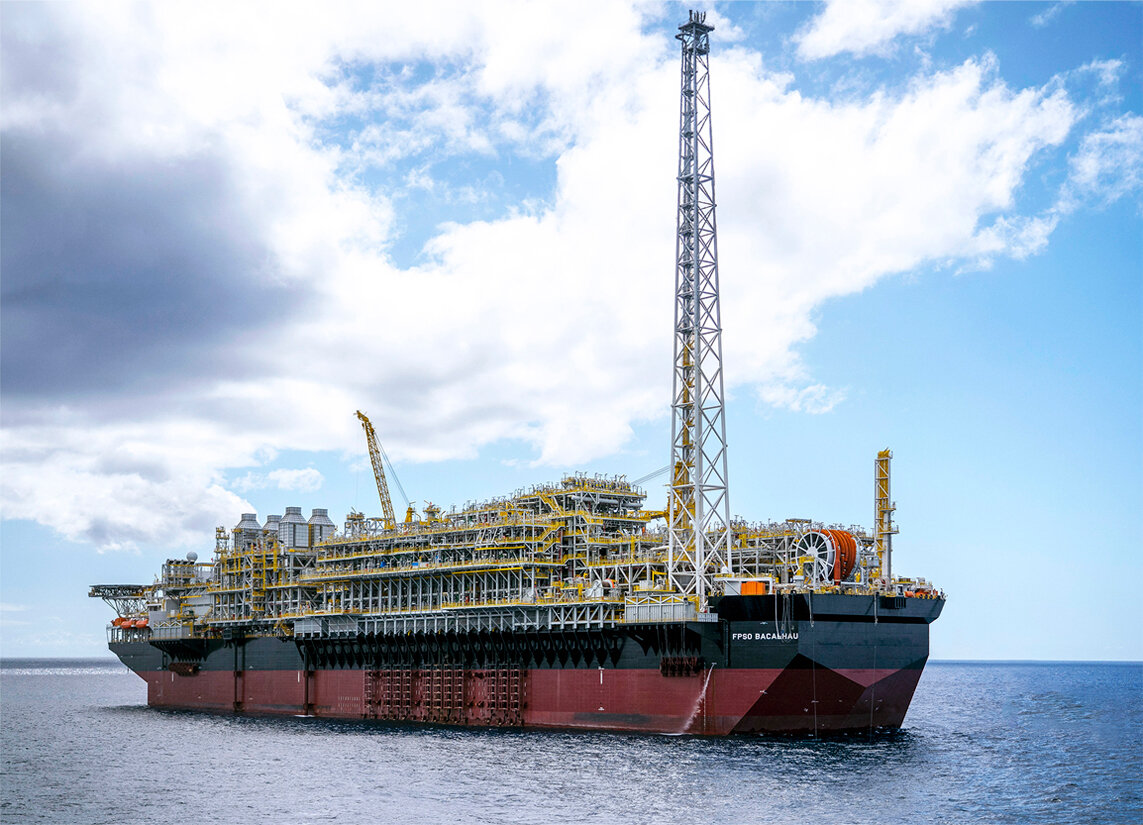
MODEC, Inc. ("MODEC") is proud to announce that the FPSO Bacalhau has achieved First Oil production as of October 15. This milestone also marks our successful delivery for Equinor Brasil Energia Ltda, a subsidiary of Equinor ASA ("Equinor"), on their first pre-salt project in Brazil.
The FPSO Bacalhau is deployed at the Bacalhau field, located in the BM-S-8 and Carcará North blocks within the pre-salt region of the Santos Basin, approximately 185 kilometers off the coast of Ilhabela, São Paulo. Equinor's partners in the field include ExxonMobil Brasil, Petrogal Brasil (JV Galp|Sinopec), and Pré-sal Petróleo SA (PPSA).
Permanently moored at a water depth of around 2,050 meters using a spread mooring system supplied by MODEC group company SOFEC, Inc., the FPSO Bacalhau is one of the largest FPSOs ever delivered to Brazil. The facility is designed to produce up to 220,000 barrels of crude oil per day. It also boasts a minimum crude oil storage capacity of 2,000,000 barrels. The FPSO is also designed with gas turbine combined cycle (GTCC), a technology that significantly reduces carbon intensity.
The FPSO Bacalhau features MODEC's innovative M350 Hull, which offers enhanced topside capacity, greater storage than conventional VLCC tankers, and a longer service life.
This vessel represents MODEC's 17th FPSO/FSO delivery in Brazil, the 9th FPSO in the pre-salt region, and MODEC's first collaboration with Equinor.
16 Oct 2025
MODEC, Inc. ("MODEC") is proud to announce that the FPSO Bacalhau has achieved First Oil production as of October 15. This milestone also marks our successful delivery for Equinor Brasil Energia Ltda, a subsidiary of Equinor ASA ("Equinor"), on their first pre-salt project in Brazil.
The FPSO Bacalhau is deployed at the Bacalhau field, located in the BM-S-8 and Carcará North blocks within the pre-salt region of the Santos Basin, approximately 185 kilometers off the coast of Ilhabela, São Paulo. Equinor's partners in the field include ExxonMobil Brasil, Petrogal Brasil (JV Galp|Sinopec), and Pré-sal Petróleo SA (PPSA).
Permanently moored at a water depth of around 2,050 meters using a spread mooring system supplied by MODEC group company SOFEC, Inc., the FPSO Bacalhau is one of the largest FPSOs ever delivered to Brazil. The facility is designed to produce up to 220,000 barrels of crude oil per day. It also boasts a minimum crude oil storage capacity of 2,000,000 barrels. The FPSO is also designed with gas turbine combined cycle (GTCC), a technology that significantly reduces carbon intensity.
The FPSO Bacalhau features MODEC's innovative M350 Hull, which offers enhanced topside capacity, greater storage than conventional VLCC tankers, and a longer service life.
This vessel represents MODEC's 17th FPSO/FSO delivery in Brazil, the 9th FPSO in the pre-salt region, and MODEC's first collaboration with Equinor.
#57
MODEC / Re: FPSO Bacalhau
Last post by Administrator - Apr 11, 2026, 03:13 AMFPSO Bacalhau - World First New Built FPSO with DNV Abate Notation
18 Jul 2024
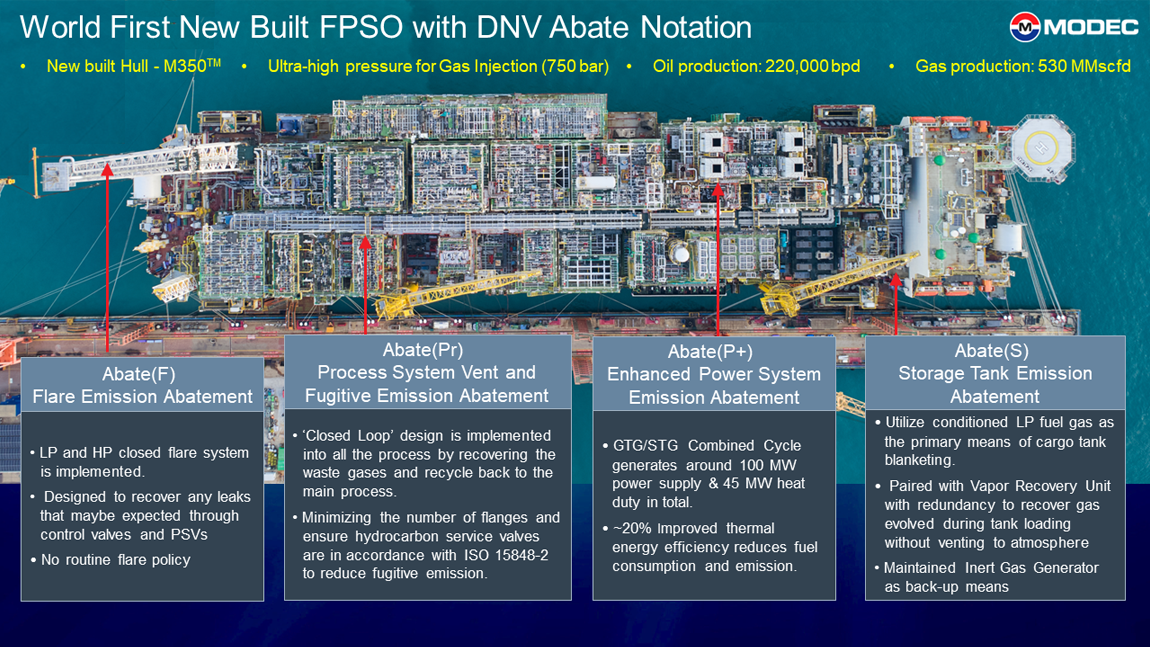
MODEC, Inc. ("MODEC") is pleased to announce that FPSO Bacalhau has received the Approval in Principle (AiP) for Abate Notation from classification society DNV, making it the first new built FPSO in the world to achieve this prestigious recognition.
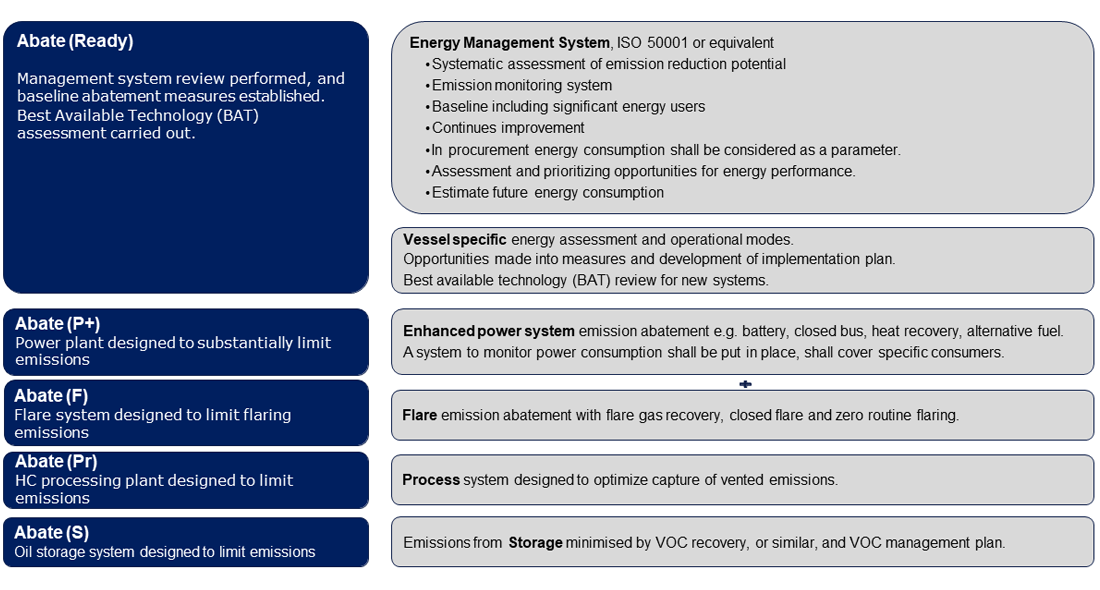
In this project, a comprehensive assessment of greenhouse gas emissions abatement on FPSO Bacalhau was conducted according to DNV guidelines*1. The Abate notation requires stringent management of emission systems (similar to ISO 50001 Energy Management requirements) and the implementation of substantial abatement measures onboard to prevent non-emergency flaring and optimize the efficiency of power/heat generation. These measures have positioned FPSO Bacalhau at the forefront of the industry for the lowest carbon emissions per barrel of oil produced.
The overview of the measures is shown below. MODEC obtained AiP of Abate Notation (P+, F, Pr, S) for FPSO Bacalhau.
18 Jul 2024
MODEC, Inc. ("MODEC") is pleased to announce that FPSO Bacalhau has received the Approval in Principle (AiP) for Abate Notation from classification society DNV, making it the first new built FPSO in the world to achieve this prestigious recognition.
In this project, a comprehensive assessment of greenhouse gas emissions abatement on FPSO Bacalhau was conducted according to DNV guidelines*1. The Abate notation requires stringent management of emission systems (similar to ISO 50001 Energy Management requirements) and the implementation of substantial abatement measures onboard to prevent non-emergency flaring and optimize the efficiency of power/heat generation. These measures have positioned FPSO Bacalhau at the forefront of the industry for the lowest carbon emissions per barrel of oil produced.
The overview of the measures is shown below. MODEC obtained AiP of Abate Notation (P+, F, Pr, S) for FPSO Bacalhau.
#58
MODEC / Re: FPSO Bacalhau
Last post by Administrator - Apr 11, 2026, 03:11 AMMODEC's Bacalhau FPSO Project for offshore Brazil proceeds to EPCI Phase with FID by Equinor
30 Jun 2021
MODEC, Inc. ("MODEC") is pleased to announce that on June 1, 2021, Equinor Brasil Energia Ltda, a subsidiary of Equinor ASA ("Equinor"), took its Final Investment Decision (FID) for a Floating Production Storage and Offloading (FPSO) vessel for the Bacalhau field offshore Brazil.
Following a Sales and Purchase Agreement (SPA) for the FPSO which was signed between Equinor and MODEC in January 2020, with respect to the Front End Engineering Design (FEED) and pre-investment of the FPSO, MODEC has now officially been awarded the contract for Engineering, Procurement, Construction and Installation (EPCI) for the FPSO. MODEC will also provide Equinor with operations and maintenance service of the FPSO for the first year from its first oil production, after which Equinor plans to operate the FPSO until end of the license period in 2053.
The FPSO will be deployed at the Bacalhau field in the BM-S-8 and Carcará North blocks located in the giant "pre-salt" region of the Santos Basin some 185 kilometers off the coast of the municipality of Ilhabela/SP, in the state of São Paulo. Equinor's field partners are ExxonMobil (40%), Petrogal Brasil (20%) and Pre-sal Petroleo SA (PPSA).
The FPSO vessel will be permanently moored at a water depth of approximately 2,050 meters by a spread mooring system to be supplied by MODEC group company, SOFEC, Inc.
The FPSO will be one of the largest FPSO ever delivered to Brazil. It will have a large topside designed to produce up to 220,000 barrels of crude oil per day, produce and inject up to 530 million standard cubic feet of associated gas per day and inject up to 200,000 barrels of seawater per day. Its minimum storage capacity of crude oil will be 2,000,000 barrels. As a remarkable point, the project will use a Combined Cycle Power Generation System as a solution to help reduce CO2 emission of the facility on the operational phase.
The FPSO will be the first application of MODEC's "M350 Hull", a next generation new built hull for FPSOs, full double hull design, which has been developed to accommodate larger topside and larger storage capacity than conventional VLCC tankers, with a longer design service life.
30 Jun 2021
MODEC, Inc. ("MODEC") is pleased to announce that on June 1, 2021, Equinor Brasil Energia Ltda, a subsidiary of Equinor ASA ("Equinor"), took its Final Investment Decision (FID) for a Floating Production Storage and Offloading (FPSO) vessel for the Bacalhau field offshore Brazil.
Following a Sales and Purchase Agreement (SPA) for the FPSO which was signed between Equinor and MODEC in January 2020, with respect to the Front End Engineering Design (FEED) and pre-investment of the FPSO, MODEC has now officially been awarded the contract for Engineering, Procurement, Construction and Installation (EPCI) for the FPSO. MODEC will also provide Equinor with operations and maintenance service of the FPSO for the first year from its first oil production, after which Equinor plans to operate the FPSO until end of the license period in 2053.
The FPSO will be deployed at the Bacalhau field in the BM-S-8 and Carcará North blocks located in the giant "pre-salt" region of the Santos Basin some 185 kilometers off the coast of the municipality of Ilhabela/SP, in the state of São Paulo. Equinor's field partners are ExxonMobil (40%), Petrogal Brasil (20%) and Pre-sal Petroleo SA (PPSA).
The FPSO vessel will be permanently moored at a water depth of approximately 2,050 meters by a spread mooring system to be supplied by MODEC group company, SOFEC, Inc.
The FPSO will be one of the largest FPSO ever delivered to Brazil. It will have a large topside designed to produce up to 220,000 barrels of crude oil per day, produce and inject up to 530 million standard cubic feet of associated gas per day and inject up to 200,000 barrels of seawater per day. Its minimum storage capacity of crude oil will be 2,000,000 barrels. As a remarkable point, the project will use a Combined Cycle Power Generation System as a solution to help reduce CO2 emission of the facility on the operational phase.
The FPSO will be the first application of MODEC's "M350 Hull", a next generation new built hull for FPSOs, full double hull design, which has been developed to accommodate larger topside and larger storage capacity than conventional VLCC tankers, with a longer design service life.
#59
MODEC / FPSO Raia - BM-C-33
Last post by Administrator - Apr 11, 2026, 03:07 AMMODEC Awarded Contract by Equinor to Supply the 2nd FPSO in Brazil
May 10, 2023
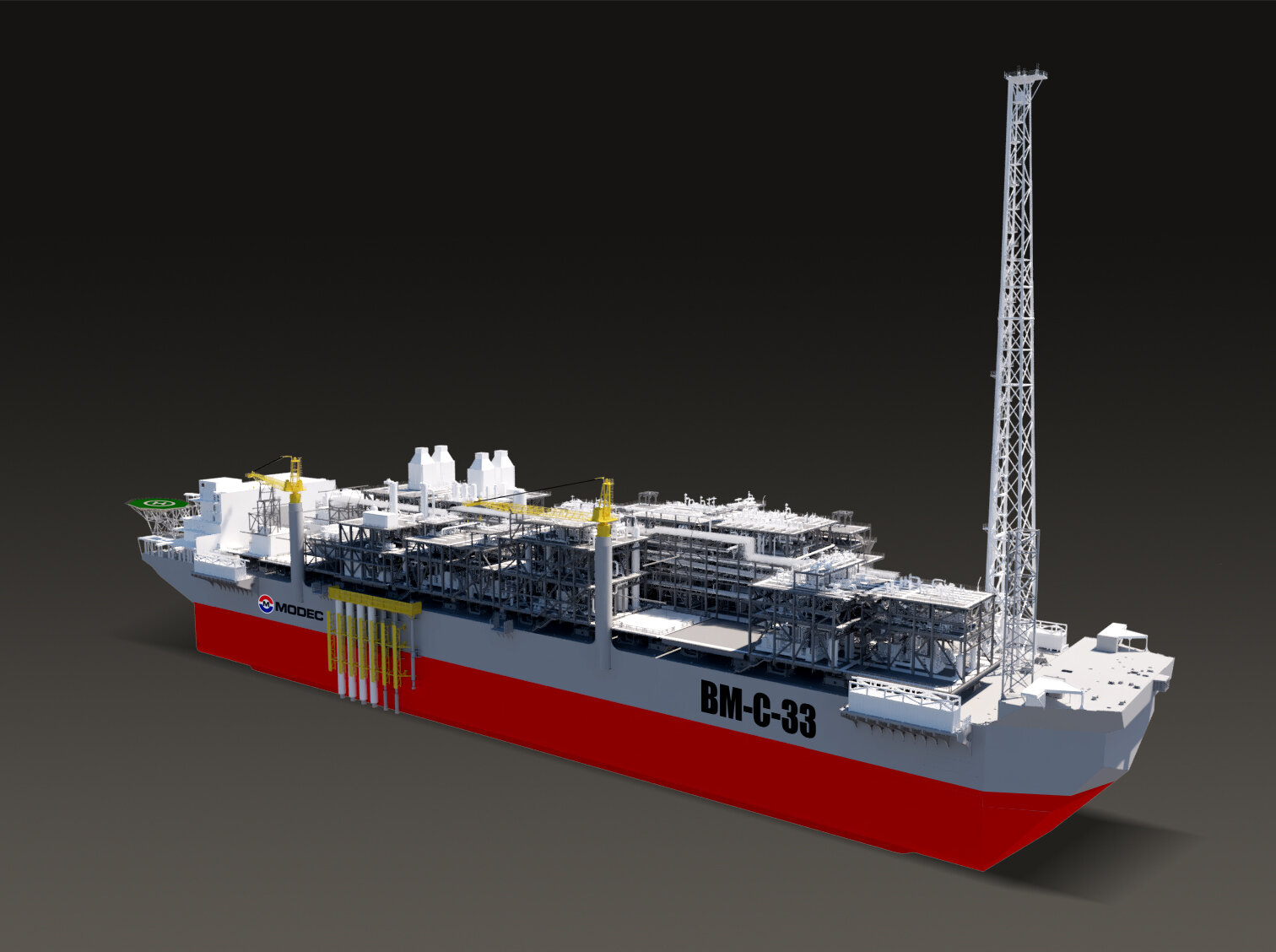
MODEC, Inc. ("MODEC") is pleased to announce that it has signed a Sales and Purchase Agreement (SPA) with Equinor Brasil Energia Ltd, a subsidiary of Equinor ASA ("Equinor"), to supply a Floating Production, Storage and Offloading (FPSO) vessel to produce the field cluster of Pao de Acucar, Seat & Gavea in the BM-C-33 block of the Campos Basin offshore Brazil. The FPSO is one of the most complex facilities in MODEC's history, handling large volumes of exported gas with a major focus on GHG emissions reduction.
The SPA is a two-phase lump sum turnkey contract covering both Front End Engineering Design (FEED) and Engineering, Procurement, Construction and Installation (EPCI) for the entire FPSO. As Equinor and partners announced the Final Investment Decision (FID) on May 8,2023 after the completion of the FEED which had started on April 2022, MODEC has now been awarded phase 2 of the contract for EPCI of the FPSO. MODEC will also provide Equinor with operations and maintenance service of the FPSO for the first year from its first oil production, after which Equinor plans to operate the FPSO.
The FPSO vessel will be deployed at the field, located in the giant "pre-salt" region at the southern part of Campos Basin, approximately 200 kilometers off the coast of Rio de Janeiro, and permanently moored at a water depth of approximately 2,900 meters. The spread mooring system will be supplied by MODEC group company, SOFEC, Inc. Equinor's field partners are Repsol Sinopec Brazil (35%) and Petrobras (30%). The FPSO delivery is expected in 2027.
MODEC will be responsible for the design and construction of the FPSO, including topsides processing equipment and hull marine systems. The FPSO will have topsides designed to produce approximately 125,000 barrels of crude oil per day as well as produce and export approximately 565 million standard cubic feet of associated gas per day. Its minimum storage capacity of crude oil will be 2,000,000 barrels.
The FPSO will apply MODEC's new build, full double hull design, developed to accommodate larger topsides and larger storage capacity than conventional VLCC tankers, with a longer design service life.
Taking advantage of this larger topside space, this FPSO will be the second fully electrified FPSO equipped with Combined Cycle System for Power Generation which significantly reduces carbon emission compared with conventional Gas Turbine driven systems.
"We are extremely honored and proud to be selected to provide an FPSO for the BM-C-33 project," commented Takeshi Kanamori, President and CEO of MODEC. "We are equally proud of the confidence Equinor obviously has in MODEC. We believe this award represents a strong relationship of trust between us built upon the ongoing Bacalhau FPSO project as well as our robust track record in the pre-salt region. We look forward to cooperating closely with Equinor and partners to make this project a success."
The FPSO will be 18th FPSO/FSO vessel and 10th FPSO in the pre-salt region delivered by MODEC in Brazil.
May 10, 2023
MODEC, Inc. ("MODEC") is pleased to announce that it has signed a Sales and Purchase Agreement (SPA) with Equinor Brasil Energia Ltd, a subsidiary of Equinor ASA ("Equinor"), to supply a Floating Production, Storage and Offloading (FPSO) vessel to produce the field cluster of Pao de Acucar, Seat & Gavea in the BM-C-33 block of the Campos Basin offshore Brazil. The FPSO is one of the most complex facilities in MODEC's history, handling large volumes of exported gas with a major focus on GHG emissions reduction.
The SPA is a two-phase lump sum turnkey contract covering both Front End Engineering Design (FEED) and Engineering, Procurement, Construction and Installation (EPCI) for the entire FPSO. As Equinor and partners announced the Final Investment Decision (FID) on May 8,2023 after the completion of the FEED which had started on April 2022, MODEC has now been awarded phase 2 of the contract for EPCI of the FPSO. MODEC will also provide Equinor with operations and maintenance service of the FPSO for the first year from its first oil production, after which Equinor plans to operate the FPSO.
The FPSO vessel will be deployed at the field, located in the giant "pre-salt" region at the southern part of Campos Basin, approximately 200 kilometers off the coast of Rio de Janeiro, and permanently moored at a water depth of approximately 2,900 meters. The spread mooring system will be supplied by MODEC group company, SOFEC, Inc. Equinor's field partners are Repsol Sinopec Brazil (35%) and Petrobras (30%). The FPSO delivery is expected in 2027.
MODEC will be responsible for the design and construction of the FPSO, including topsides processing equipment and hull marine systems. The FPSO will have topsides designed to produce approximately 125,000 barrels of crude oil per day as well as produce and export approximately 565 million standard cubic feet of associated gas per day. Its minimum storage capacity of crude oil will be 2,000,000 barrels.
The FPSO will apply MODEC's new build, full double hull design, developed to accommodate larger topsides and larger storage capacity than conventional VLCC tankers, with a longer design service life.
Taking advantage of this larger topside space, this FPSO will be the second fully electrified FPSO equipped with Combined Cycle System for Power Generation which significantly reduces carbon emission compared with conventional Gas Turbine driven systems.
"We are extremely honored and proud to be selected to provide an FPSO for the BM-C-33 project," commented Takeshi Kanamori, President and CEO of MODEC. "We are equally proud of the confidence Equinor obviously has in MODEC. We believe this award represents a strong relationship of trust between us built upon the ongoing Bacalhau FPSO project as well as our robust track record in the pre-salt region. We look forward to cooperating closely with Equinor and partners to make this project a success."
The FPSO will be 18th FPSO/FSO vessel and 10th FPSO in the pre-salt region delivered by MODEC in Brazil.
#60
MODEC / FPSO Léopold Sédar Senghor
Last post by Administrator - Apr 11, 2026, 03:06 AM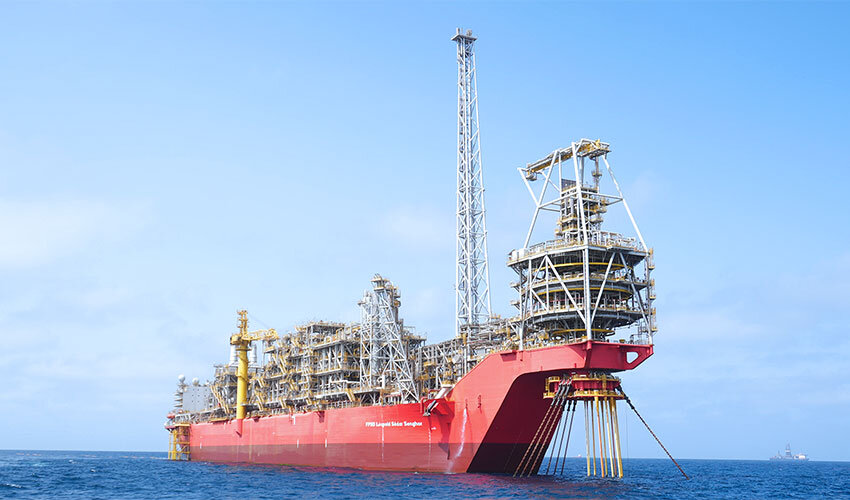
The FPSO Léopold Sédar Senghor is deployed at the Sangomar (formerly SNE) field located approximately 100 km south of Dakar, Senegal. The Sangomar Field Development is the first offshore oil development in the country.
MODEC was awarded a Front End Engineering Design (FEED) contract of the FPSO in February 2019 and the FPSO purchase contract following the Final Investment Decision (FID) in January 2020.
The FPSO vessel is permanently moored at a water depth of approximately 780 m by an External Turret mooring system supplied by SOFEC, Inc., a MODEC group company.
The FPSO is capable of processing 100,000 barrels of crude oil per day, 130 million standard cubic feet of gas per day, 145,000 barrels of water injection per day and has a minimum storage capacity of 1,300,000 barrels of crude oil.